
The Ghost Search Phenomenon: Why Your Google Traffic is Vanishing (and How to Survive 2026)
I. The Analytics Mystery: Why #1 Doesn't Mean What It Used To
It’s the phone call every digital marketer dreads. You’re looking at a client’s (or your own) Search Console. The rankings are perfect. You are sitting at the coveted #1 spot for your primary keywords. But then you look at the “Clicks” column.
It’s a ghost town.
Welcome to the Ghost Search Phenomenon. In 2026, the traditional path of “Search → Click → Website” is breaking. Data from early this year shows that over 60% of Google searches and nearly 90% of AI-Mode searches now result in a “zero-click.” The user gets their answer, closes the tab, and your website—despite being the source of that information—gets nothing but a “ghost” impression.
As I build my digital marketing portfolio, I’ve realized that learning SEO in 2026 isn’t about learning how to rank anymore; it’s about learning how to be the Source of Truth in a world that no longer wants to click.
II. What Exactly is the Ghost Search Phenomenon?
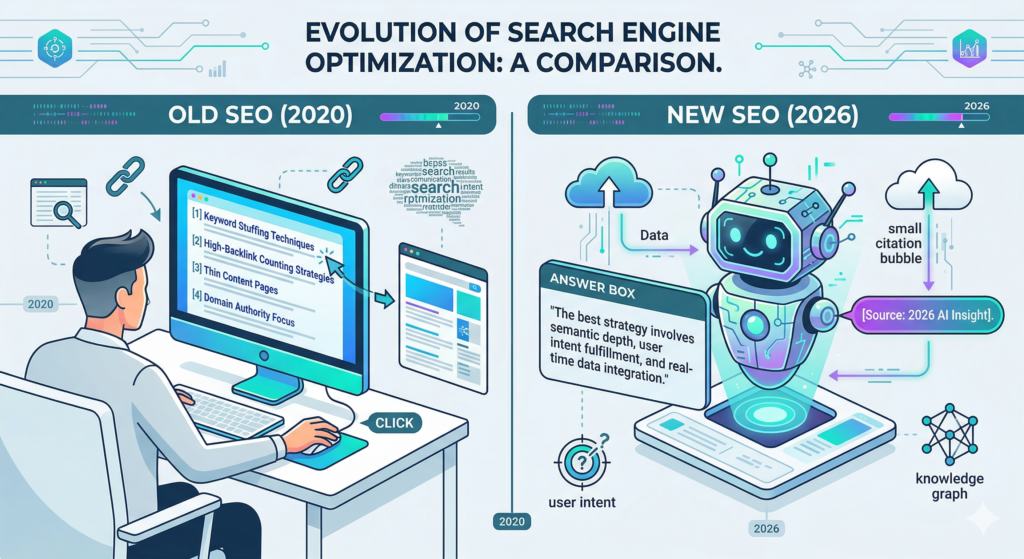
The Ghost Search Phenomenon occurs when AI-powered search engines (like Google Gemini or SearchGPT) summarize your content so effectively that the user has no incentive to visit your page.
The 2026 Search Experience looks like this:
The Query: A user asks, “How do I calculate ROI for a local SEO campaign?”
The AI Overview: Google generates a 4-step breakdown, a formula, and a concluding tip.
The Result: The user has the answer. They never click your link. You get the “Search Impression,” but zero traffic.
For those of us entering the industry now, this feels like a betrayal. We were taught that content is king. But in 2026, Synthesis is the new King. Search engines are no longer “libraries” of links; they are “answer engines” that use your content as raw material.
III. The Death of the "What Is" Keyword
If your strategy relies on defining terms, you are already losing. AI has completely monopolized “Informational Intent.”
Dead Keywords: “What is SEO,” “Benefits of Digital Marketing,” “How to bake a cake.”
Why? These have binary, factual answers. AI can summarize these perfectly.
To survive, we must pivot to Information Gain. This is a technical SEO concept where Google rewards content that provides new info that isn’t already in its database. If you just repeat what Wikipedia says, the AI will “ghost” you. If you provide a unique case study or a contrarian opinion, the AI is forced to cite you to maintain its own credibility.
IV. Search Everywhere Optimization (S.E.O. 2.0)
In my research, I’ve discovered that the most successful brands in 2026 have moved beyond Google. We now practice Search Everywhere Optimization.
To build a resilient portfolio, you need to be visible where the AI gets its “trust signals”:
Reddit & Quora: Google is heavily weighting human-to-human discussions. If people aren’t talking about your brand on Reddit, the AI assumes you aren’t a “real-world” authority.
Vertical Search: TikTok for lifestyle, LinkedIn for B2B, and Pinterest for visual niches.
The Citation Game: The new “Ranking #1” is being the #1 cited source in an AI Overview.
V. My 3-Step Framework for "Anti-Ghost" Content
As a digital marketer in training, I’ve developed a framework I use for every project in my portfolio to ensure we don’t just get impressions—we get impact.
1. The “Click Gap” Strategy
Give the AI the “What,” but keep the “How” on your site. For example:
AI Summary: “The best way to fix a 404 error is using a 301 redirect.”
Your Site: “Here is the specific Python script we wrote to automate 5,000 redirects in 10 minutes.” Users will click because they need the tool, not just the theory.
2. High-Density E-E-A-T
Experience, Expertise, Authoritativeness, and Trustworthiness. In 2026, this isn’t a suggestion; it’s a filter. I make sure every post includes:
Real-world data/screenshots.
“I” statements (e.g., “In my experiment, I found…”).
Authorship schema that links to my professional social profiles.
3. The “Subject-Is-Predicate” Structure
AI bots scan for clear facts. Instead of saying, “It is often thought that SEO is quite important,” I write, “SEO is a foundational revenue driver.” This clear structure makes it easier for AI to extract your content as a “Fact Node,” increasing your citation rate.
VI. Why This Matters for My Portfolio
You might wonder why a digital marketing learner is focusing on such a high-level shift. The answer is simple: The industry is resetting. The “experts” of 2020 are currently panicking because their old playbooks are failing. By starting my journey in the “Ghost Search” era, I am building my skills on the most current, battle-tested foundations. I am not just learning how to drive clicks; I am learning how to build Digital Authority.
VII. Conclusion: Facing the Ghost
The Ghost Search Phenomenon isn’t the death of digital marketing—it’s the death of mediocre content. We are moving into an era where being “good enough” results in zero traffic. To win, we have to be indispensable.
We have to provide the data that AI can’t invent, the stories that AI can’t feel, and the tools that AI can’t build.
Work With Me
I am currently documenting my experiments in navigating the 2026 SEO landscape.
If you are looking for a digital marketer who understands where the industry is going, not just where it’s been, I’d love to connect.
